


COP31 Antalya: from climate commitments to investable action
At a glance
- Capital is following electrification, with REACT alone targeting US$300 billion in Türkiye by 2040.
- Cost of capital is the binding constraint, as emerging economies pay up to three times more to borrow.
- Grids, electrical equipment, and industrial decarbonisation offer the strongest crossborder M&A opportunities.
COP31 put electrification, grids, and industrial decarbonisation at the centre of the climate agenda, and capital followed. Türkiye’s 35-by-35 pledge, to raise electricity’s share of global final energy demand to 35% by 2035, won the backing of the European Union (EU), and development banks, lenders, and industrial groups used the summit to launch investment platforms.[1][2]
The negotiations proved harder, and talks closed on 22 November without an overarching political agreement.[3] For investors and advisors, the more useful signals from Antalya concern the cost of capital, the race to electrify, and where money is starting to flow.
Leaders, business, and the economic cost of delay
Leaders in Antalya agreed on the need for action and divided on who should bear the cost. UN secretary-general António Guterres warned that climate impacts are advancing faster than the international response and pointed to a fundamental imbalance: emerging and developing economies outside China account for nearly two-thirds of humanity, yet receive less than one-fifth of global clean-energy investment and often pay two to three times more to borrow. That makes the transition a cost-of-capital challenge as much as a technological one.[4]
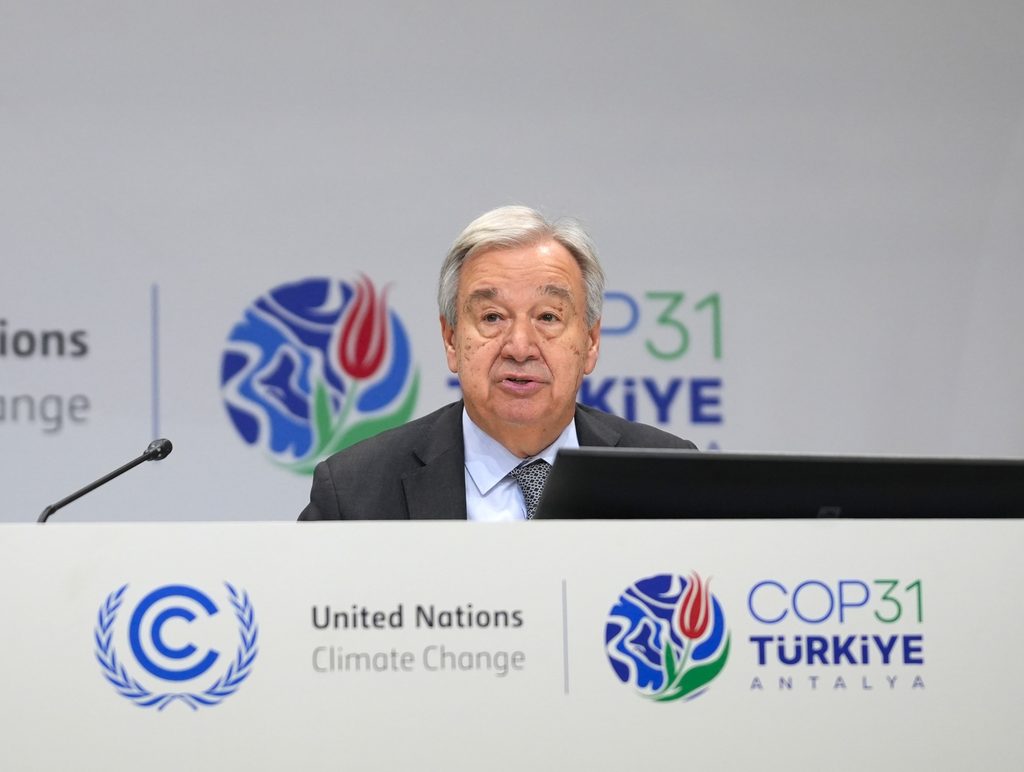
“The brutal truth is that the climate crisis is outrunning us.”
Antonio Guterres, UN secretary-general, 11 November 2026
Brazil’s president, Luiz Inácio Lula da Silva, host of COP30, warned that governments were prioritising arms and tariffs over climate action.[5] His warning points to a basic investment risk: projects with multi-decade lifetimes need a predictable policy framework. China’s vice president, Han Zheng, said developed countries should take the lead on emissions cuts and honour their climate finance commitments.[6] European Commission president Ursula von der Leyen set a higher bar for Europe, aiming for electricity to supply 46% of the EU’s final energy use by 2040.[2] Small island leaders demanded grants rather than loans so that climate funding does not deepen their debt.[7][8]
Business participation was unusually visible. At a session hosted by Koç Holding, COP31’s Global Business Partner, Al Gore gave the keynote and International Energy Agency (IEA) chief Fatih Birol moderated a panel including Allianz CEO Oliver Bäte, Octopus Energy CEO Greg Jackson, and European Bank for Reconstruction and Development (EBRD) president Odile Renaud-Basso.[9] BBVA, the Global Banking Partner, ran more than 60 sessions linking climate policy to investable business plans.[10] Lenders increasingly treat a borrower’s power sourcing, carbon exposure, and physical resilience as factors that affect cash flows, borrowing capacity, and ultimately enterprise value.
Electrification: a global industrial agenda
Clean power is scaling fast. Renewables generated 34% of global electricity in 2025, overtaking coal for the first time in a century, and solar alone met nearly three-quarters of the growth in global electricity demand.[11][4] The constraint now lies in grids, transformers, storage, and connection access, which determine how quickly new capacity reaches customers and how investors value it.
Manufacturers are moving closer to demand. Nordex, the wind-turbine maker in which Spain’s Acciona is the largest shareholder, started production at a new blade plant in İzmir in May 2026, designed to employ around 1,200 people at full capacity.[12]
Multilateral finance: from strategy to bankable projects
Multilateral institutions absorb early risks, mobilise co-investors, and create bankable structures where commercial funding falls short. Türkiye launched its Renewable Energy Acceleration and Clean Transition (REACT) platform, which aims to mobilise US$300 billion by 2040, and the EBRD joined as an initial signatory with plans to invest US$6 billion over five years.[13] The Türkiye Industrial Decarbonisation Investment Platform, which targets EUR 5 billion by 2030 in steel, cement, aluminium, and fertilisers, added new partners, and four development banks signed ten agreements with Türkiye worth US$5.1 billion.[14][15] Deployment is already accelerating: Türkiye’s solar capacity rose from 24.8 GW to 28.1 GW in the nine months to September 2026.[16]
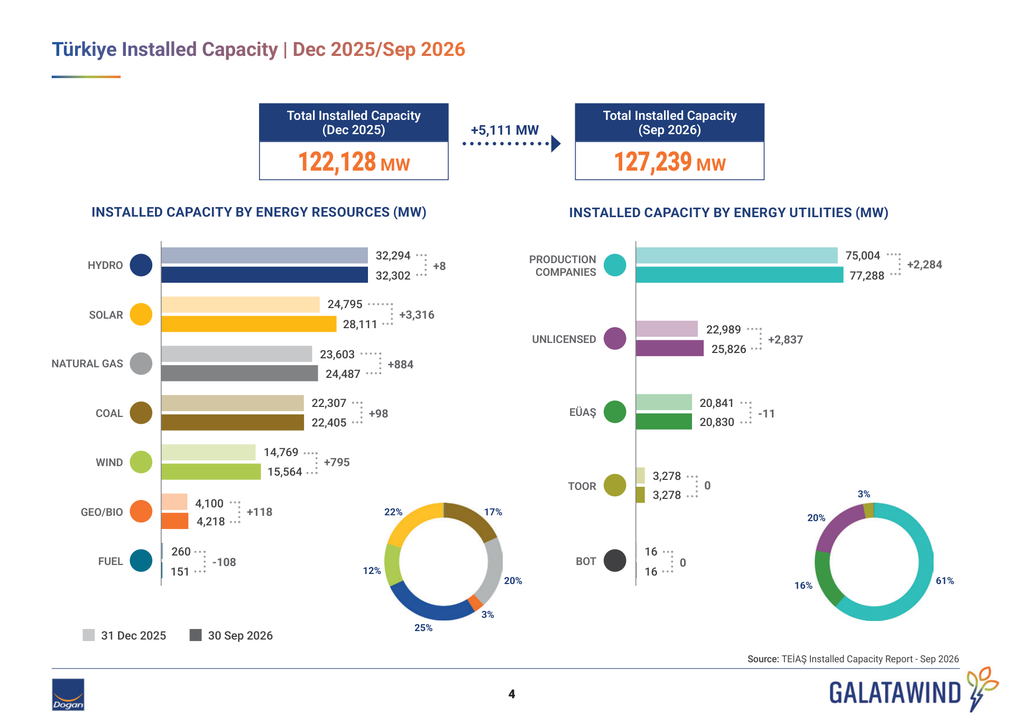
Türkiye’s installed electricity capacity by source, December 2025 and September 2026. Source: Galata Wind Enerji A.Ş., Q3 2026 investor presentation, using data from TEİAŞ, Türkiye’s national electricity transmission operator.[16]
What COP31 means for crossborder M&A
Buyers and lenders will favour platforms with resilient cash flows, proven technologies, and credible execution. Four areas stand out:
- Renewable platforms: operating portfolios, developers, minority stakes, and asset rotations, as global developers recycle capital and infrastructure funds seek scale.
- Grid and electrical equipment: transformers, cables, switchgear, power electronics, and storage, where industrial buyers seek capacity, technology, and local market access.
- Industrial decarbonisation: technology suppliers, joint ventures, and non-core disposals as energy-intensive sectors invest to stay competitive.
- Resilience: water management, resilient buildings, and climate-risk services, which often carry different revenue drivers from generation assets.
Deal structures will widen: minority growth capital, project finance, development-bank participation, and joint ventures can bridge gaps in risk appetite or funding tenor. Execution will decide returns: BCG’s 2026 study of 144 listed energy companies found that, over the decade to July 2026, companies at the 75th percentile of their peer groups outperformed those at the 25th by an average of six percentage points in annualised total shareholder return.[17]
Across the Clairfield partnership, these themes translate into concrete questions for clients: which development platforms can scale internationally, which grid-technology manufacturers need strategic capital, and which industrial groups may rotate assets or enter new markets.
Conclusions: a diplomatic setback, with investment momentum intact
Whilst Antalya produced no political agreement, the reasons matter for investors. The EU, the United Kingdom, Norway, Panama, and several island states rejected a final text that made no reference to transitioning away from fossil fuels, a text China and India accepted, and disputes over climate finance for developing economies remained unresolved.[18] Policy divisions will persist. Energy security, industrial competitiveness, and electrification still give investors reasons to act.
Industrial groups are already acting. WEG, the Brazil-headquartered electrical equipment and industrial technology group, manufactures in Türkiye and joined COP31 panels and business forums. Reflecting on the summit, Marco Antonio Campos, managing director of WEG Türkiye, identified four areas of contribution: energy efficiency, operational efficiency through automation and digitalisation, renewable energy technologies, and electric mobility.[19] Companies that decarbonise their own operations whilst selling the technologies that help customers do the same are well placed as the transition moves from policy to procurement.
The next phase of the energy transition will rely increasingly on corporate investment, technological innovation, development finance, and crossborder partnerships, alongside international policy agreements. These are the areas where M&A and strategic capital advisory make the difference.
By Müge Tuna, Executive Director, Clairfield in Türkiye
Sources
[1] Al Jazeera, “Turkiye pushes electrification top of climate agenda as COP31 set to open”, 9 November 2026: https://www.aljazeera.com/news/2026/11/9/turkiye-pushes-electrification-top-of-climate-agenda-as-cop31-set-to-open
[2] The Brussels Times, von der Leyen at COP31: https://www.brusselstimes.com/2404403/eu-sets-2040-goal-to-cut-emissions-by-90-amid-growing-urgency
[3] NBC News, “COP31 climate talks break down after angry dispute over fossil fuels”, 22 November 2026: https://www.nbcnews.com/science/climate-change/cop31-climate-talks-break-angry-dispute-fossil-fuels-rcna610656
[4] UNFCCC, transcript of António Guterres’s remarks to the COP31 Leaders’ Summit, 11 November 2026: https://unfccc.int/node/663987
[5] CNN Brasil, “Lula critica foco de países em ‘armas e tarifas’ durante a COP31”: https://www.cnnbrasil.com.br/internacional/lula-cop-31-armas-e-tarifas-sobrevivencia/
[6] Ministry of Foreign Affairs of the People’s Republic of China, remarks by vice president Han Zheng, 11 November 2026: https://us.china-embassy.gov.cn/eng/zgyw/202611/t20261112_12058202.htm
[7] China Daily Hong Kong, “COP31 urges ‘faster’ action”, 13 November 2026: https://www.chinadailyhk.com/article/642663
[8] Pacific Islands News Association, Solomon Islands and Niue leaders at COP31: https://pina.com.fj/?p=79717
[9] Koç Holding press release, 11 November 2026: https://macaubusiness.com/ali-y-koc-the-energy-transition-has-become-the-cornerstone-of-competitiveness-in-industry/
[10] BBVA, COP31 programme: https://www.bbva.com/en/sustainability/bbva-to-address-how-to-mobilize-finance-to-move-from-ambition-to-action-at-cop31/
[11] Ember, Global Electricity Review 2026, 21 April 2026: https://ember-energy.org/latest-updates/solar-surge-halts-fossil-electricity-growth-worldwide-in-2025/
[12] Nordex Group, start of production at Menemen blade plant, 22 May 2026: https://www.renewable-energy-industry.com/news/press-releases/pm-8829-nordex-group-starts-production-at-new-blade-manufacturing-facility-in-tuerkiye
[13] EBRD, “EBRD plans US$ 6 billion for Türkiye’s REACT projects over 5 years”, 11 November 2026: https://www.ebrd.com/home/news-and-events/news/2026/ebrd-plans-us-usd-6bn-for-turkiyes-react-projects-over-5-years.html
[14] EBRD, “EBRD welcomes expansion of Türkiye’s TIDIP”: https://www.ebrd.com/home/news-and-events/news/2026/ebrd-welcomes-expansion-of-tuerkiye-s-tidip.html
[15] Hürriyet Daily News, “Türkiye signs $5.1 billion in deals with 4 development banks at COP31”: https://www.hurriyetdailynews.com/amp/turkiye-signs-5-1-billion-in-deals-with-4-development-banks-at-cop31-229303
[16] Galata Wind Enerji A.Ş., Q3 2026 investor presentation, p. 4, using TEİAŞ data
[17] BCG, “Winning Energy’s Next Investment Cycle”, 8 October 2026: https://www.bcg.com/publications/2026/energy-companies-creating-value
[18] bne IntelliNews, “COP31 in Turkey collapses without deal as EU rejects text silent on fossil fuels”, 22 November 2026: https://www.yahoo.com/news/world/articles/cop31-turkey-collapses-without-deal-000618355.html
[19] Automation Magazine, “WEG to participate in COP31 in Antalya”: https://www.automationmagazine.co.uk/weg-to-participate-in-cop31-in-antalya/; WEG energy transition pillars: https://www.weg.net/institutional/MG/it/energy-transition; Invest in Türkiye, WEG Kocaeli plant: https://www.invest.gov.tr/en/news/news-from-turkey/pages/brasil-based-weg-invests-new-electric-motor-plant.aspx
